🎉 Up to 70% Off Selected ItemsShop Sale

HomeStore
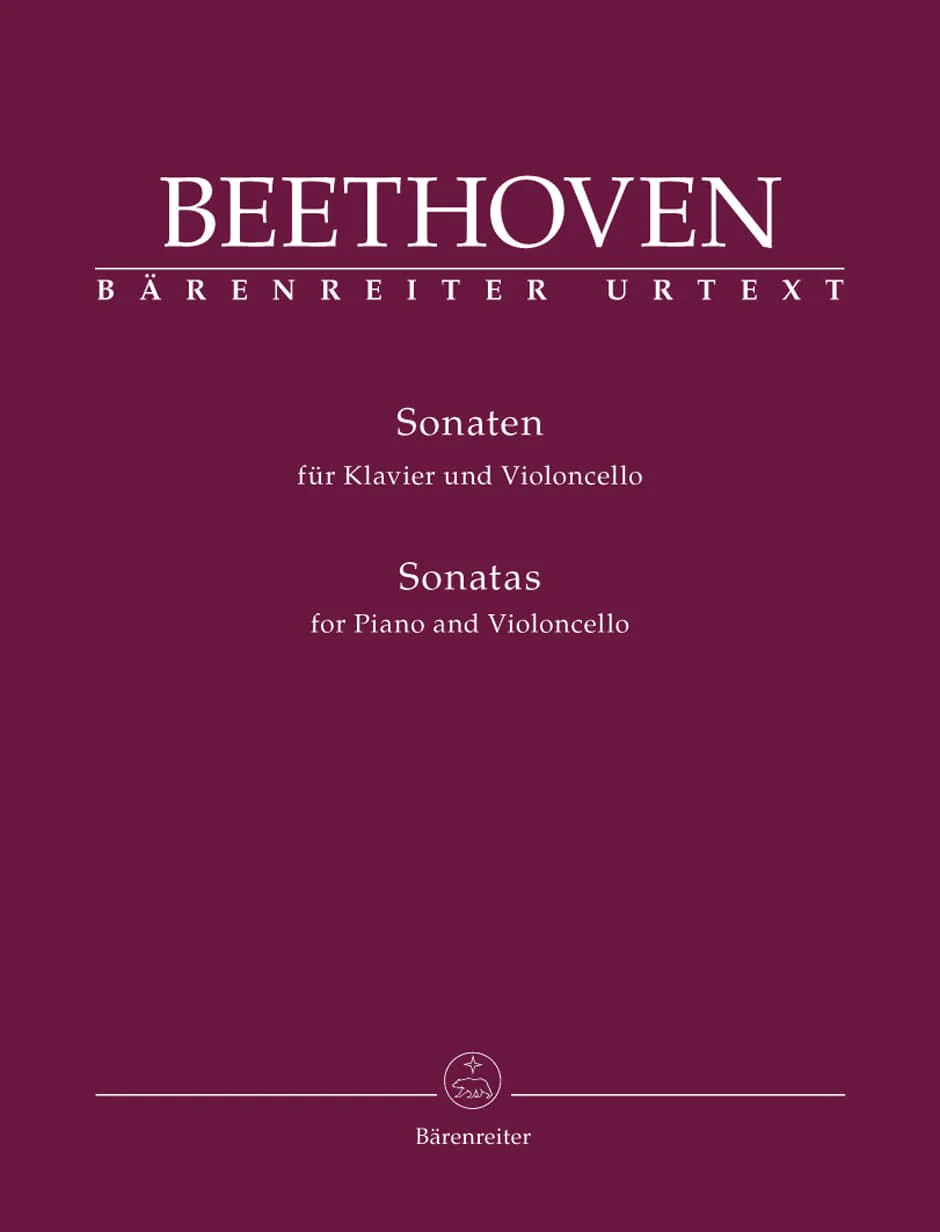
Beethoven, Ludwig - Sonatas Op 5, 69, 102 for Cello and Piano - Edited by Del Mar - Barenreiter URTEXT Edition
Beethoven, Ludwig - Sonatas Op 5, 69, 102 for Cello and Piano - Edited by Del Mar - Barenreiter URTEXT Edition
Sonata Number 1 in F Major Op. 5 for Cello and Piano is very representative of Beethoven's early works. Prior to Beethoven's five cello sonatas, the instrument was largely used in an accompanying role -- Beethoven's contemporaries didn't even write solo pieces for the cello. This piece is the first time the cello was elevated to such a prominent level, and Beethoven's later works continue to expand this trend.
The sonata Number 2 in g minor, Op. 5 for Cello and Piano, written during Beethoven's early period, begins to display some of the independence characteristic of his second, middle period. The sonata, like his first and fourth, only features two movements. It gradually builds from the Adagio introduction into the Allegro first movement, eventually culminating in the arpeggiated finale of the second Allegro movement.
Beethoven's Cello Sonata Number 3 in A Major Opus 69 was revolutionary when it was composed in 1808. The cello introduces the first theme completely solo, and following themes are expressed as a conversation between the two instruments. The first movement is slower than typical, followed by an unexpectedly fast second movement and then again a very slow introduction to the lively final movement.
Beethoven's Sonata Number 4 in C Major for Cello and Piano was composed in 1815, during which time Beethoven was beginning to encounter an overwhelming number of difficulties, physical and social. When published in 1817, listeners didn't know how to react to this sonata. Featuring only two movements, the cello alone begins the sonata and, when joined by the piano, retains a leading role, complementing the piano in the melody. The second and final movement, by contrast, is an exciting fugue with an unexpected ending...
Beethoven's 5th and last cello sonata returns to more traditional form compared to the 4th sonata, though it continues Beethoven's trend of giving the cello a more prominent role in the melody than typical. This sonata, particularly the second movement, begins to exhibit the dark and eccentric style that characterized Beethoven's late quartets and piano works.
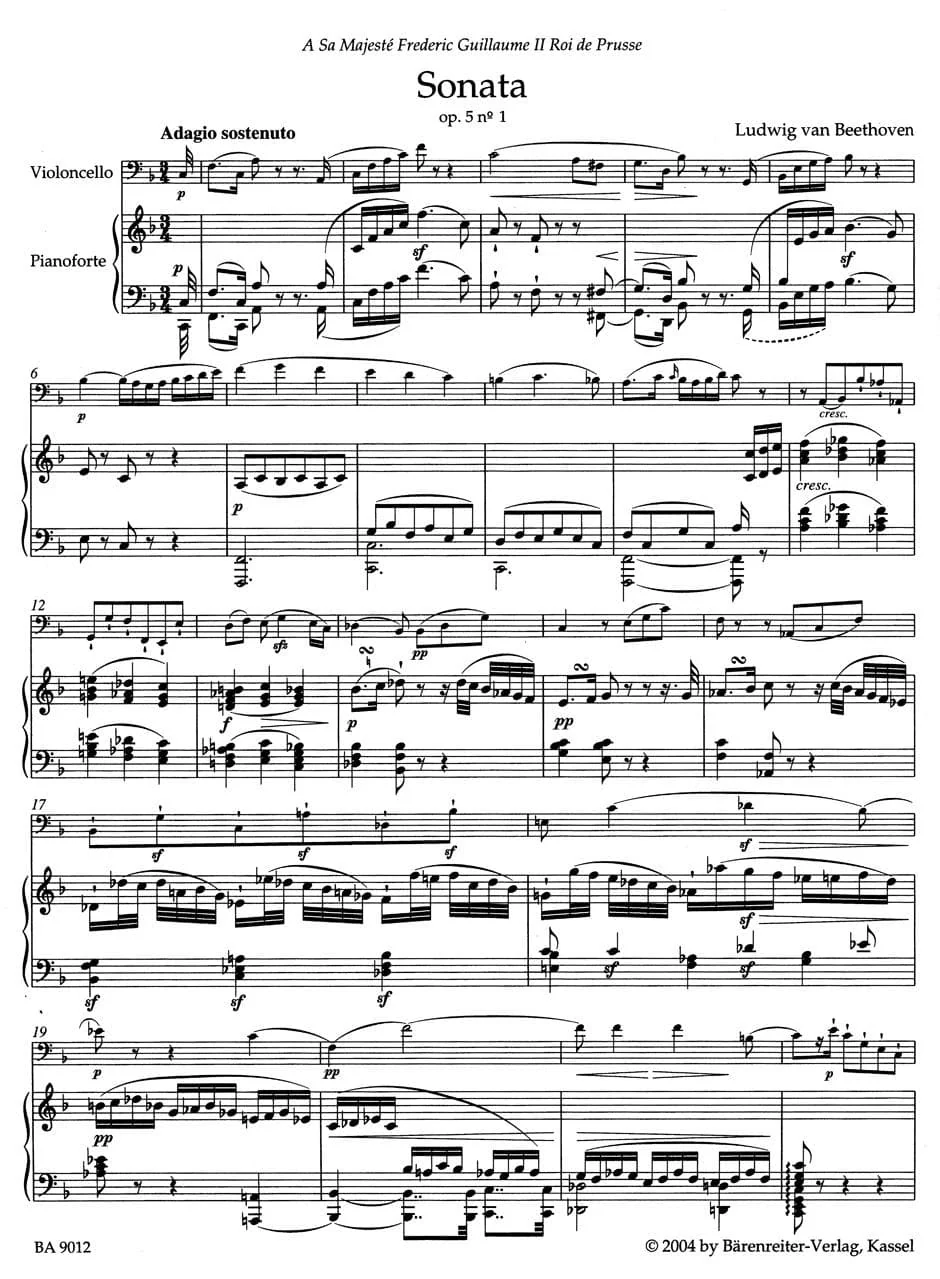
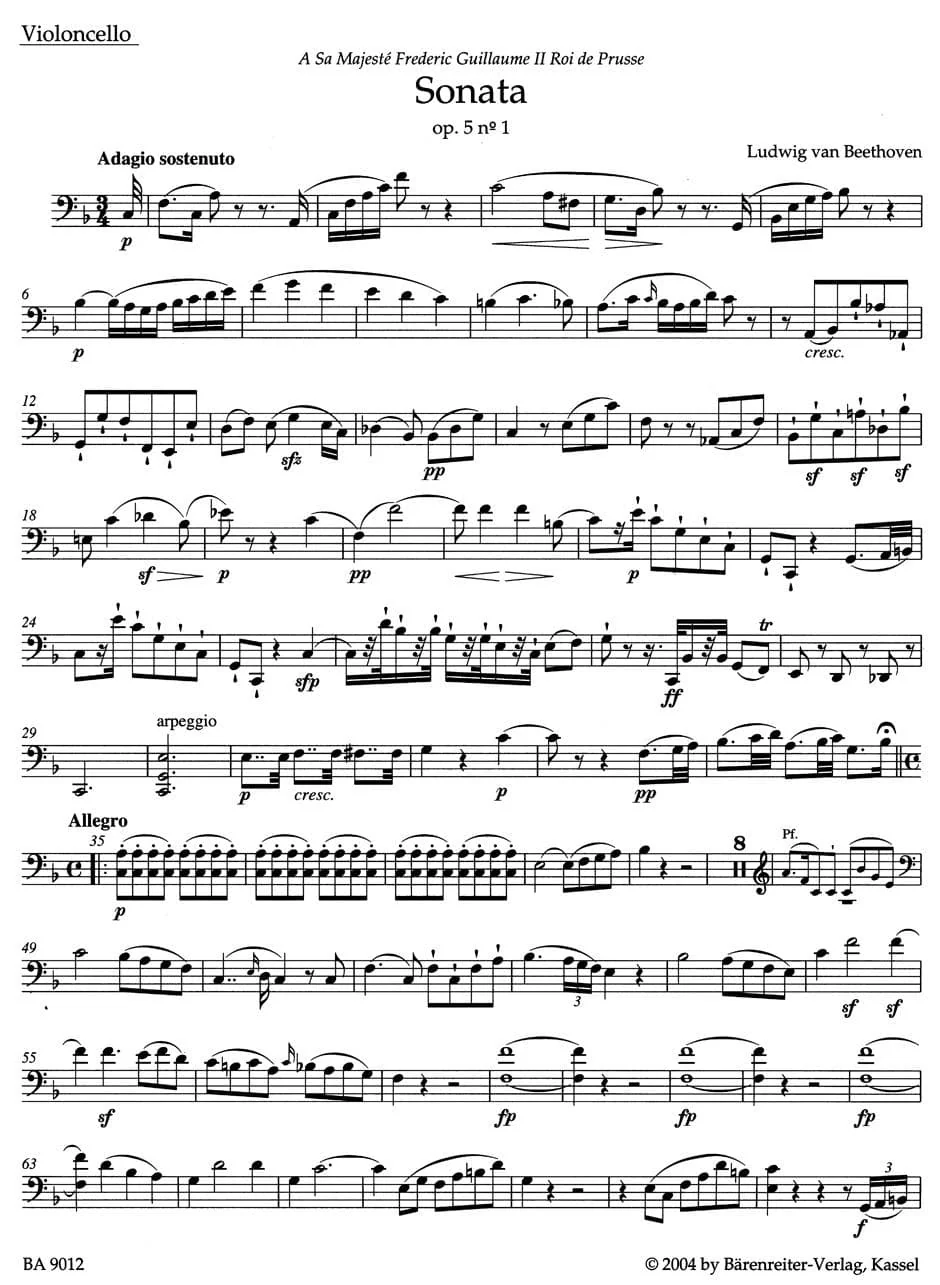
Barenreiter URTEXT edition of the Beethoven Sonatas for Cello and Piano. Critical scholarly performing edition edited by Jonathan Del Mar.
Opus 5, Nos 1 & 2
Opus 69
Opus 102, Nos 1 & 2.
Difficutly: ASTA Grade 6
The sonata Number 2 in g minor, Op. 5 for Cello and Piano, written during Beethoven's early period, begins to display some of the independence characteristic of his second, middle period. The sonata, like his first and fourth, only features two movements. It gradually builds from the Adagio introduction into the Allegro first movement, eventually culminating in the arpeggiated finale of the second Allegro movement.
Beethoven's Cello Sonata Number 3 in A Major Opus 69 was revolutionary when it was composed in 1808. The cello introduces the first theme completely solo, and following themes are expressed as a conversation between the two instruments. The first movement is slower than typical, followed by an unexpectedly fast second movement and then again a very slow introduction to the lively final movement.
Beethoven's Sonata Number 4 in C Major for Cello and Piano was composed in 1815, during which time Beethoven was beginning to encounter an overwhelming number of difficulties, physical and social. When published in 1817, listeners didn't know how to react to this sonata. Featuring only two movements, the cello alone begins the sonata and, when joined by the piano, retains a leading role, complementing the piano in the melody. The second and final movement, by contrast, is an exciting fugue with an unexpected ending...
Beethoven's 5th and last cello sonata returns to more traditional form compared to the 4th sonata, though it continues Beethoven's trend of giving the cello a more prominent role in the melody than typical. This sonata, particularly the second movement, begins to exhibit the dark and eccentric style that characterized Beethoven's late quartets and piano works.
Barenreiter URTEXT edition of the Beethoven Sonatas for Cello and Piano. Critical scholarly performing edition edited by Jonathan Del Mar.
Opus 5, Nos 1 & 2
Opus 69
Opus 102, Nos 1 & 2.
Difficutly: ASTA Grade 6
$15.64
Original: $44.69
-65%Beethoven, Ludwig - Sonatas Op 5, 69, 102 for Cello and Piano - Edited by Del Mar - Barenreiter URTEXT Edition—
$44.69
$15.64More Images

Beethoven, Ludwig - Sonatas Op 5, 69, 102 for Cello and Piano - Edited by Del Mar - Barenreiter URTEXT Edition
Sonata Number 1 in F Major Op. 5 for Cello and Piano is very representative of Beethoven's early works. Prior to Beethoven's five cello sonatas, the instrument was largely used in an accompanying role -- Beethoven's contemporaries didn't even write solo pieces for the cello. This piece is the first time the cello was elevated to such a prominent level, and Beethoven's later works continue to expand this trend.
The sonata Number 2 in g minor, Op. 5 for Cello and Piano, written during Beethoven's early period, begins to display some of the independence characteristic of his second, middle period. The sonata, like his first and fourth, only features two movements. It gradually builds from the Adagio introduction into the Allegro first movement, eventually culminating in the arpeggiated finale of the second Allegro movement.
Beethoven's Cello Sonata Number 3 in A Major Opus 69 was revolutionary when it was composed in 1808. The cello introduces the first theme completely solo, and following themes are expressed as a conversation between the two instruments. The first movement is slower than typical, followed by an unexpectedly fast second movement and then again a very slow introduction to the lively final movement.
Beethoven's Sonata Number 4 in C Major for Cello and Piano was composed in 1815, during which time Beethoven was beginning to encounter an overwhelming number of difficulties, physical and social. When published in 1817, listeners didn't know how to react to this sonata. Featuring only two movements, the cello alone begins the sonata and, when joined by the piano, retains a leading role, complementing the piano in the melody. The second and final movement, by contrast, is an exciting fugue with an unexpected ending...
Beethoven's 5th and last cello sonata returns to more traditional form compared to the 4th sonata, though it continues Beethoven's trend of giving the cello a more prominent role in the melody than typical. This sonata, particularly the second movement, begins to exhibit the dark and eccentric style that characterized Beethoven's late quartets and piano works.
Barenreiter URTEXT edition of the Beethoven Sonatas for Cello and Piano. Critical scholarly performing edition edited by Jonathan Del Mar.
Opus 5, Nos 1 & 2
Opus 69
Opus 102, Nos 1 & 2.
Difficutly: ASTA Grade 6
The sonata Number 2 in g minor, Op. 5 for Cello and Piano, written during Beethoven's early period, begins to display some of the independence characteristic of his second, middle period. The sonata, like his first and fourth, only features two movements. It gradually builds from the Adagio introduction into the Allegro first movement, eventually culminating in the arpeggiated finale of the second Allegro movement.
Beethoven's Cello Sonata Number 3 in A Major Opus 69 was revolutionary when it was composed in 1808. The cello introduces the first theme completely solo, and following themes are expressed as a conversation between the two instruments. The first movement is slower than typical, followed by an unexpectedly fast second movement and then again a very slow introduction to the lively final movement.
Beethoven's Sonata Number 4 in C Major for Cello and Piano was composed in 1815, during which time Beethoven was beginning to encounter an overwhelming number of difficulties, physical and social. When published in 1817, listeners didn't know how to react to this sonata. Featuring only two movements, the cello alone begins the sonata and, when joined by the piano, retains a leading role, complementing the piano in the melody. The second and final movement, by contrast, is an exciting fugue with an unexpected ending...
Beethoven's 5th and last cello sonata returns to more traditional form compared to the 4th sonata, though it continues Beethoven's trend of giving the cello a more prominent role in the melody than typical. This sonata, particularly the second movement, begins to exhibit the dark and eccentric style that characterized Beethoven's late quartets and piano works.
Barenreiter URTEXT edition of the Beethoven Sonatas for Cello and Piano. Critical scholarly performing edition edited by Jonathan Del Mar.
Opus 5, Nos 1 & 2
Opus 69
Opus 102, Nos 1 & 2.
Difficutly: ASTA Grade 6
Product Information
Product Information
Shipping & Returns
Shipping & Returns
Description
Sonata Number 1 in F Major Op. 5 for Cello and Piano is very representative of Beethoven's early works. Prior to Beethoven's five cello sonatas, the instrument was largely used in an accompanying role -- Beethoven's contemporaries didn't even write solo pieces for the cello. This piece is the first time the cello was elevated to such a prominent level, and Beethoven's later works continue to expand this trend.
The sonata Number 2 in g minor, Op. 5 for Cello and Piano, written during Beethoven's early period, begins to display some of the independence characteristic of his second, middle period. The sonata, like his first and fourth, only features two movements. It gradually builds from the Adagio introduction into the Allegro first movement, eventually culminating in the arpeggiated finale of the second Allegro movement.
Beethoven's Cello Sonata Number 3 in A Major Opus 69 was revolutionary when it was composed in 1808. The cello introduces the first theme completely solo, and following themes are expressed as a conversation between the two instruments. The first movement is slower than typical, followed by an unexpectedly fast second movement and then again a very slow introduction to the lively final movement.
Beethoven's Sonata Number 4 in C Major for Cello and Piano was composed in 1815, during which time Beethoven was beginning to encounter an overwhelming number of difficulties, physical and social. When published in 1817, listeners didn't know how to react to this sonata. Featuring only two movements, the cello alone begins the sonata and, when joined by the piano, retains a leading role, complementing the piano in the melody. The second and final movement, by contrast, is an exciting fugue with an unexpected ending...
Beethoven's 5th and last cello sonata returns to more traditional form compared to the 4th sonata, though it continues Beethoven's trend of giving the cello a more prominent role in the melody than typical. This sonata, particularly the second movement, begins to exhibit the dark and eccentric style that characterized Beethoven's late quartets and piano works.
Barenreiter URTEXT edition of the Beethoven Sonatas for Cello and Piano. Critical scholarly performing edition edited by Jonathan Del Mar.
Opus 5, Nos 1 & 2
Opus 69
Opus 102, Nos 1 & 2.
Difficutly: ASTA Grade 6
The sonata Number 2 in g minor, Op. 5 for Cello and Piano, written during Beethoven's early period, begins to display some of the independence characteristic of his second, middle period. The sonata, like his first and fourth, only features two movements. It gradually builds from the Adagio introduction into the Allegro first movement, eventually culminating in the arpeggiated finale of the second Allegro movement.
Beethoven's Cello Sonata Number 3 in A Major Opus 69 was revolutionary when it was composed in 1808. The cello introduces the first theme completely solo, and following themes are expressed as a conversation between the two instruments. The first movement is slower than typical, followed by an unexpectedly fast second movement and then again a very slow introduction to the lively final movement.
Beethoven's Sonata Number 4 in C Major for Cello and Piano was composed in 1815, during which time Beethoven was beginning to encounter an overwhelming number of difficulties, physical and social. When published in 1817, listeners didn't know how to react to this sonata. Featuring only two movements, the cello alone begins the sonata and, when joined by the piano, retains a leading role, complementing the piano in the melody. The second and final movement, by contrast, is an exciting fugue with an unexpected ending...
Beethoven's 5th and last cello sonata returns to more traditional form compared to the 4th sonata, though it continues Beethoven's trend of giving the cello a more prominent role in the melody than typical. This sonata, particularly the second movement, begins to exhibit the dark and eccentric style that characterized Beethoven's late quartets and piano works.
Barenreiter URTEXT edition of the Beethoven Sonatas for Cello and Piano. Critical scholarly performing edition edited by Jonathan Del Mar.
Opus 5, Nos 1 & 2
Opus 69
Opus 102, Nos 1 & 2.
Difficutly: ASTA Grade 6